


What Does an EICR Check in a Property?
An electrical installation can appear to work perfectly while hiding defects behind a consumer unit, socket front or ceiling void. The question, “what does an EICR check”, is therefore about far more than whether the lights come on. It is a detailed inspection and test of the fixed electrical installation, designed to identify damage, deterioration, poor workmanship and issues that could put people or property at risk.
For homeowners, landlords, business owners and site managers across Blackpool and the Fylde Coast, an Electrical Installation Condition Report - usually called an EICR - provides a clear picture of the condition of the wiring and associated equipment. It is not a test of every portable appliance you own, nor is it a guarantee that no fault can ever develop. It is a professional assessment of the installation at the time it is inspected.
What Does an EICR Check?
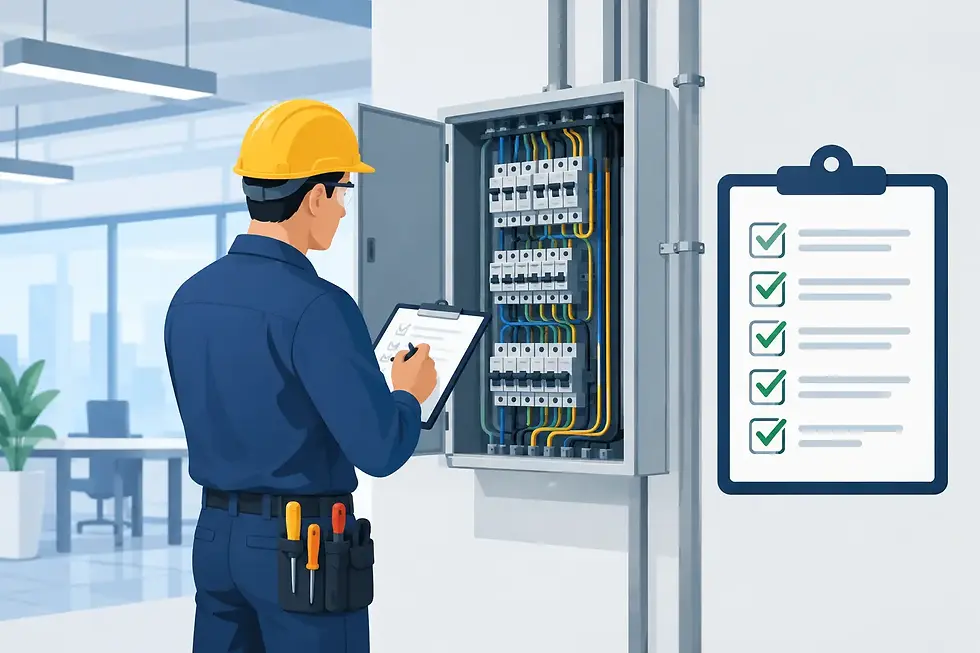
An EICR checks the parts of an electrical system that are fixed in place. This normally includes the consumer unit or distribution board, wiring, sockets, switches, light fittings, earthing and bonding arrangements, isolators and any permanently connected equipment within the agreed scope of work.
The electrician begins with a visual inspection. They look for obvious signs of concern, such as cracked accessories, exposed conductors, overheating, unsuitable alterations, missing blanking plates, damaged enclosures or old wiring that has deteriorated with age. Older properties can sometimes contain obsolete cable types or equipment that no longer provides the level of protection expected from a modern installation.
Testing then confirms whether the safety measures are working as they should. Depending on the installation, this may include checks on earthing continuity, insulation resistance, polarity, fault loop impedance and the operation of RCDs or RCBOs. These tests help establish whether protective devices are likely to disconnect the supply quickly enough if a fault occurs.
In a commercial or industrial setting, the inspection may also take account of distribution equipment, emergency lighting circuits, three-phase supplies, machinery isolators and electrical systems affected by the way the premises are used. A busy workshop, holiday accommodation, office or rental property can each present different demands, so the inspection needs to reflect the actual environment.
What an EICR Does Not Cover
An EICR is often confused with portable appliance testing, commonly known as PAT testing. PAT testing concerns plug-in appliances such as kettles, computers, extension leads and power tools. An EICR concerns the fixed installation supplying them.
It also does not usually cover every item in a property without agreement. For example, a landlord’s report may cover the electrical installation in a flat but not a tenant’s personal appliances. Likewise, fixed equipment may need separate specialist servicing where required, such as fire alarms, emergency lighting systems or machinery controls. A competent electrician will explain the scope before work starts, so there is no uncertainty about what is being inspected.
Why Testing Matters When Everything Seems Fine
Electrical faults are not always visible or dramatic. Loose connections can generate heat over time. An incorrectly wired socket can function but still create a serious risk. A damaged cable hidden under flooring may only become apparent when formal testing reveals reduced insulation resistance.
RCD protection is another common area of concern. These devices are designed to reduce the risk of electric shock by disconnecting the circuit rapidly when they detect certain faults. However, an RCD that fails to operate, is incorrectly connected or does not protect the circuits that need it can leave occupants exposed. Testing confirms operation rather than relying on assumption.
For landlords, an EICR is also a legal duty in most private rented homes in England. The report must be obtained at least every five years, or sooner if the previous report recommends an earlier date. A satisfactory report should be provided to tenants and retained as evidence of compliance. If remedial work is identified, it must be addressed within the required timescale.
Homeowners are not generally subject to the same five-year legal requirement, but regular inspection remains sensible, particularly after buying a property, undertaking alterations, experiencing flooding or storm damage, or noticing recurring faults. Businesses have wider responsibilities to maintain electrical systems safely under workplace health and safety requirements. The right interval depends on the premises, its use, the condition of the installation and the level of risk.
How EICR Results Are Graded
After the inspection, the electrician issues a report recording the observations made, test results and overall outcome. A satisfactory result means no observations have been identified that require urgent or recommended remedial work under the report’s classification system. It does not mean the installation is brand new or that improvements could never be beneficial.
An unsatisfactory report will normally include one or more coded observations. These codes help you understand the urgency:
C1 - Danger present: Immediate action is required because there is a risk of injury. The electrician may make the area safe before leaving, where possible.
C2 - Potentially dangerous: Urgent remedial work is needed. The defect may not pose an immediate danger at that moment, but it could become hazardous.
FI - Further investigation required: The electrician has identified an issue that cannot be fully assessed without additional work or investigation.
C3 - Improvement recommended: This does not make the report unsatisfactory on its own, but it highlights an improvement that would enhance safety or bring parts of the installation closer to current standards.
A C1, C2 or FI observation results in an unsatisfactory EICR. This distinction matters. A report is not a quotation for unnecessary upgrades, and not every older component must be replaced simply because newer products are available. The focus is on safety, condition and compliance with the standards relevant to the inspection.
What Happens During an EICR Visit?
The amount of disruption depends on the size and complexity of the premises. In a typical home, power may need to be switched off for periods while circuits are tested. It is helpful to ensure the consumer unit is accessible, rooms can be entered safely and any known electrical issues are mentioned at the start.
For landlords and property managers, arranging access to all areas is essential. Locked cupboards, inaccessible outbuildings or tenant areas that cannot be entered may need to be listed as limitations on the report. In commercial premises, testing is best planned around trading hours, critical equipment and operational needs. Some circuits can be isolated outside normal working hours, while others may need a carefully managed shutdown.
A thorough EICR should never be treated as a rushed paperwork exercise. The time required depends on the number of circuits, the age of the installation, access, building layout and whether faults are found. A small modern flat may be straightforward; a large older property or an industrial unit with several distribution boards will require more time and planning.
Common Issues Found in Older Properties
Across Blackpool and the Fylde Coast, electrical installations can vary widely in age and condition. Properties that have been extended, converted or altered over several decades may contain a mixture of old and new work. Common findings include inadequate earthing or bonding, worn accessories, overloaded circuits, missing RCD protection, unsuitable consumer unit alterations and signs of heat damage at connections.
It is also possible to find wiring that has been affected by damp, DIY alterations or previous work that was not completed to an appropriate standard. None of these findings should be ignored, but they do not always mean a full rewire is necessary. Sometimes a focused repair, consumer unit upgrade or replacement of damaged components is the sensible solution. The report gives the evidence needed to make that decision properly.
Choosing the Right Next Step
If your EICR identifies remedial work, ask for the findings to be explained in plain language. You should understand which items are urgent, what work is proposed and whether temporary safety measures are needed. Once repairs are completed, appropriate confirmation should be provided to show the identified issues have been addressed.
For a property you own, manage or operate, an EICR is a practical way to replace uncertainty with clear information. Blackpool & Fylde Electrical Services Limited can inspect domestic, commercial and industrial installations with safety, access and day-to-day use in mind. If you have concerns about ageing wiring, repeated tripping or a report that is due, arranging an inspection before a fault becomes an emergency is a sensible place to start.


Comments