
Fuse Box vs Consumer Unit: What’s Changed?
- Paul Wild
- Jul 6
- 6 min read
If you have ever asked about a fuse box vs consumer unit, you are usually really asking one thing - is my electrical setup old, and does it still give my property the level of protection it should? That matters whether you own a house, manage rental property, run a shop, or look after an industrial site. The wording may sound technical, but the difference has a direct impact on safety, fault protection, and how quickly power can be restored when something goes wrong.
Fuse box vs consumer unit: the basic difference
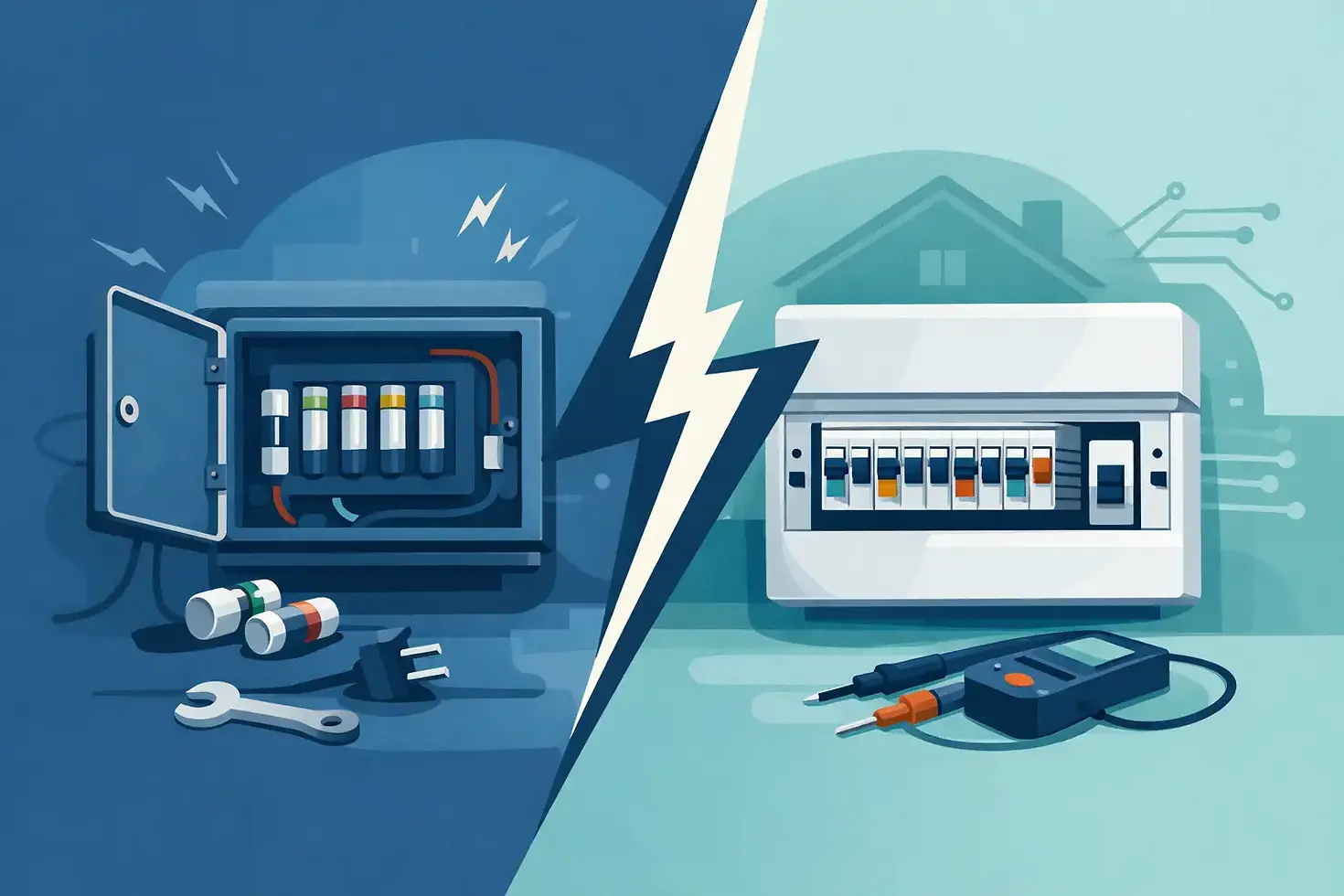
People still use the term fuse box as a catch-all for the main electrical board in a property. In older installations, that often meant a board fitted with rewirable fuses or cartridge fuses. A consumer unit is the modern version used in most homes and many smaller commercial premises, typically fitted with circuit breakers and additional safety devices such as RCDs and RCBOs.
So, in simple terms, a fuse box is often an older style of distribution board, while a consumer unit refers to a more modern assembly designed to provide stronger and faster protection. The two do the same broad job - they distribute electricity around the building and protect circuits - but they do not offer the same level of safety or convenience.
That said, it is not always as black and white as old equals dangerous and new equals perfect. Some older boards may still be serviceable in certain circumstances, while some newer boards may still need attention if they were poorly installed, overloaded, or do not meet the current needs of the property.
What an old fuse box usually contains
Traditional fuse boxes often have a row of fuse carriers protecting lighting, sockets, cooker circuits, or other supplies. If a fault occurs, the fuse wire melts and breaks the circuit. It does the job, but it is less precise and less user-friendly than modern protection.
In practical terms, that can mean longer downtime and more room for error. Replacing fuse wire is not something that should be treated casually, and using the wrong rating can create a serious risk. Older boards also commonly lack residual current protection, which is one of the key safety improvements in modern systems.
You may also find that an older fuse box has no clear labelling, limited spare capacity, and signs of age such as heat damage, brittle components, or outdated enclosures. In some properties around Blackpool and the Fylde Coast, these boards are still found in homes that have had bits added over the years without a full upgrade.
What a modern consumer unit does better
A consumer unit uses protective devices designed to disconnect faulty circuits quickly and more accurately. Miniature circuit breakers, or MCBs, protect against overloads and short circuits. RCDs help reduce the risk of electric shock by cutting power when they detect imbalance. RCBOs combine both functions on individual circuits, which can reduce nuisance tripping across the whole board.
This matters in day-to-day use. If one circuit develops a fault, a modern board often makes it easier to identify the problem and isolate only the affected area. In a home, that might mean the kitchen sockets trip while the lights stay on. In a business setting, selective protection can help limit disruption and make fault finding more efficient.
Modern consumer units are also usually built to current standards for non-combustible enclosures, improved labelling, and safer overall design. That does not mean every existing installation must be changed immediately, but it does mean the safety benchmark has moved on.
Why the terminology causes confusion
Part of the confusion comes from habit. Many electricians and customers still say fuse box because it is familiar. In everyday conversation, that is usually fine. The issue is that the term can cover very different types of equipment.
A homeowner might say the fuse box keeps tripping, when they actually have a modern consumer unit with circuit breakers. Another property owner may assume they have a modern setup because the board looks newer, but it may still lack the protective devices now expected for improved safety.
That is why proper inspection matters more than labels. The age, condition, circuit design, earthing arrangement, and protective devices all need to be considered together.
When an upgrade is worth serious thought
There are some situations where replacing an old fuse box with a modern consumer unit is strongly worth considering. One is when you still have rewirable fuses. Another is when there is no RCD protection on circuits that would now be expected to have it, such as socket outlets likely to supply outdoor equipment.
An upgrade also makes sense if you are carrying out a rewire, major renovation, extension, kitchen refit, or conversion. It is often false economy to improve the wiring in parts of the property while leaving an outdated board at the centre of the system.
Landlords and business owners should be especially careful here. Electrical safety is not just about keeping the lights on. It is also about duty of care, inspection outcomes, and reducing avoidable risk for tenants, staff, and visitors.
Signs your current board may be outdated
Sometimes the clues are obvious. You may see old style fuse carriers, a wooden backboard, missing blanks, mixed devices from different eras, or handwritten labels that no longer match the circuits. In other cases, the warning signs are operational.
Frequent tripping, crackling sounds, a burning smell, discolouration, or heat around the board should never be ignored. The same goes for a board that feels overcrowded because extra circuits have been squeezed in over time. Those issues do not always mean full replacement is the only answer, but they do mean the installation should be checked promptly by a qualified electrician.
If you have recently bought an older property and there is no clear record of inspection or upgrade work, an EICR is a sensible next step. It gives a clearer picture of whether the consumer unit is adequate and whether there are wider issues in the installation.
Fuse box vs consumer unit in rented and commercial properties
For landlords, the fuse box vs consumer unit question is often tied to compliance and risk management. A dated board may lead to coded observations during an inspection, especially if there is missing RCD protection or evidence of deterioration. Even where the installation is not immediately dangerous, older equipment can still become a recurring maintenance issue.
For shops, offices, workshops, and industrial premises, the discussion becomes more site-specific. A small office may use a board not too different from a domestic consumer unit. A larger commercial or industrial site may have distribution boards, three-phase supplies, and more complex protective coordination. In those settings, the right upgrade path depends on load demands, circuit segregation, and operational continuity as much as age alone.
Is replacing a fuse box a simple swap?
Not always. Replacing a board can reveal other problems in the installation, such as poor earthing, borrowed neutrals, inadequate bonding, damaged accessories, or old wiring that is no longer suitable. That is one reason why proper testing and assessment are essential before and during the work.
A straightforward consumer unit replacement in a sound installation is one thing. A board change in a property with ageing wiring is another. Sometimes the safest advice is to upgrade the wider installation in stages or to combine the board change with remedial works.
This is also why pricing can vary. Anyone quoting for a board replacement should be considering more than the box itself. Certification, testing, notification where required, and the condition of the existing installation all form part of the job.
What property owners should do next
If you are unsure what you have, do not guess based on age or appearance alone. Have the installation inspected properly. A qualified electrician can tell you whether your current board is an old fuse box, a more recent consumer unit, or something that sits awkwardly in between because it has been altered over time.
From there, the right decision depends on the facts. If the board is outdated, lacks modern protection, or shows signs of wear, replacement is often a sensible safety upgrade. If it is in good order but the property is changing use or adding load, it may still need improvement to suit the new demand.
For property owners across Blackpool and the Fylde Coast, the best approach is usually the simplest one - treat the electrical board as safety equipment, not just a box on the wall. If it is no longer doing that job well, it is worth putting right before it becomes an urgent fault.


Comments