

Why Does One Socket Stop Working at Home?
- Paul Wild
- 15 hours ago
- 6 min read
A phone charger works in every other outlet, but one socket has suddenly gone dead. It is a frustrating fault, particularly when it affects a kitchen, home office, shop counter or rental property. If you are asking, why does one socket stop working, the answer may be as simple as a tripped protective device - or it may point to a loose connection or damaged wiring that needs professional attention.
A socket that has lost power should not be ignored or repeatedly tested with different appliances. Electricity faults can worsen under load, and the priority is always to make the affected area safe before finding the cause.
Why does one socket stop working while others are fine?
Most sockets are connected as part of a circuit, rather than operating entirely on their own. In many properties, several outlets share the same cable run and protective device at the consumer unit. A fault at one point can therefore interrupt the supply to a single socket, or to a group of sockets further along the circuit.
The pattern of the fault matters. If only one outlet is dead but nearby ones still work, the problem may be within that socket, its connections, or the cable feeding it. If several sockets in one area have stopped working, the fault may be earlier in the circuit or linked to a tripped breaker or RCD.
Older homes across Blackpool and the Fylde Coast can have additions made at different stages over many years. Extensions, converted garages, updated kitchens and old wiring can all make a circuit less straightforward than it first appears. A qualified electrician can test the circuit properly rather than relying on assumptions about what each socket serves.
Common causes of a dead socket
A tripped circuit breaker or RCD
A circuit breaker protects against overloads and faults. An RCD, or residual current device, is designed to cut the power quickly if it detects current leaking to earth, helping reduce the risk of electric shock. Either may trip because of a faulty appliance, moisture, damaged cable, overloaded extension lead or a fault on the fixed installation.
Check the consumer unit only if it is safe to do so. Look for a breaker that is in the off position or sitting between on and off, and for an RCD that has tripped. Reset it once. If it immediately trips again, or trips when a particular appliance is plugged in, leave it off and arrange fault finding. Repeated resetting can conceal a serious issue and may cause further damage.
It is worth remembering that a tripped device is not the fault itself. It has done its job by responding to a problem somewhere on the circuit.
A loose or burnt connection
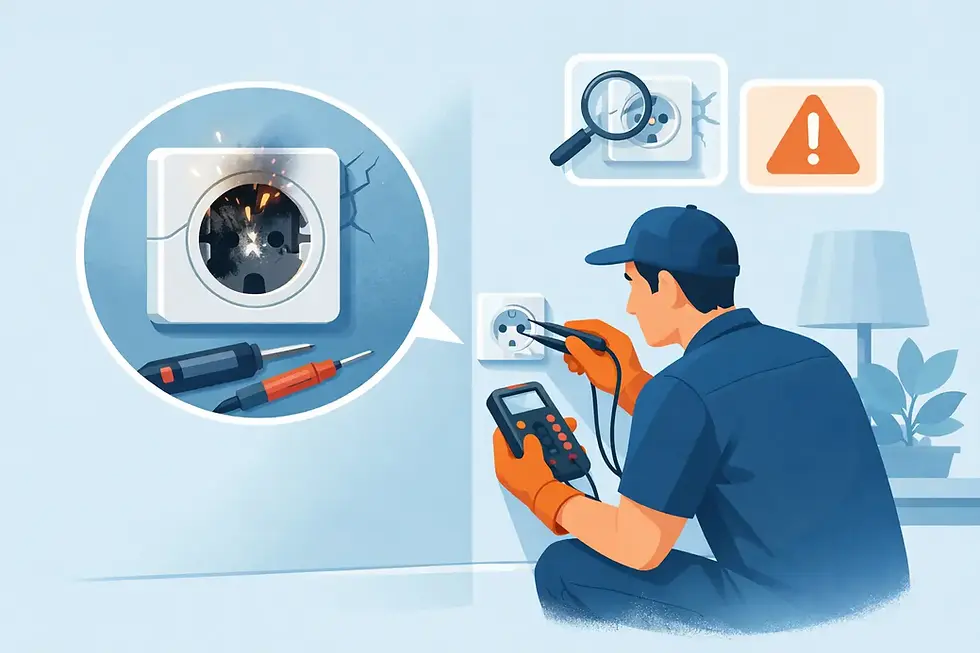
Sockets carry significant current, especially where heaters, kettles, washing machines, tumble dryers or office equipment are used. Over time, a loose terminal connection can generate heat. The result may be intermittent power, a dead socket, scorch marks, a burning smell or warmth around the faceplate.
Do not remove the socket front or tighten terminals yourself unless you are competent to carry out electrical work safely and can isolate and prove the circuit dead. Loose connections need proper inspection because the damage may extend to the cable insulation, back box or neighbouring connections.
If a socket is warm, discoloured, cracked, buzzing, sparking or smells burnt, switch off the relevant circuit at the consumer unit if you can identify it safely. Stop using the socket and seek urgent electrical assistance.
A fault at another socket on the same circuit
A dead socket is not always the socket where the fault began. On a circuit with sockets wired in sequence, a loose connection at an earlier outlet can stop power reaching the next one. This is why replacing the visibly dead socket alone may not solve the issue.
Professional fault finding involves testing continuity, polarity, insulation resistance and earth fault loop impedance as appropriate. These tests help locate the actual break or high-resistance connection, including faults hidden behind furniture, under floorboards or within a wall.
Damaged wiring or accidental drilling
A cable can be damaged by a screw, nail or drill bit during DIY work, picture hanging, kitchen fitting or renovation. Damage may cause a breaker or RCD to trip straight away, but not always. Some faults develop over time as insulation deteriorates or a conductor becomes partially severed.
Think back to any recent work near the affected area. A newly fitted shelf, curtain rail, television bracket or bathroom accessory may be relevant. Never investigate by drilling again, cutting into a wall or exposing cables. Turn off the circuit and call an electrician.
A faulty socket accessory
The outlet itself can fail. Internal contacts can wear, shutters can jam, and terminals can become damaged by heavy use or poorly fitting plugs. This is more common in busy commercial premises, holiday lets and homes where sockets have been used with multi-way adaptors for years.
A replacement socket may be required, but it should be fitted only after the circuit has been checked. If the original accessory failed due to overheating or poor connections, simply replacing it without addressing the cause creates a repeat risk.
Water, condensation or outside electrical equipment
Moisture and electrics do not mix. Condensation, a plumbing leak, damp walls, a damaged outside socket or water entering an outbuilding can trigger RCDs and damage accessories. In bathrooms, kitchens, utility rooms and external areas, the source may not be immediately visible.
Keep clear of any wet electrical equipment. Do not touch a socket, plug or switch with wet hands, and do not use it until the area is dry and has been assessed. Where water has entered an electrical installation, professional inspection is the safe course of action.
Safe checks you can make before calling an electrician
You do not need to dismantle anything to gather useful information. First, unplug appliances from the affected socket and try a known-working appliance, such as a lamp, in a different working outlet to confirm the appliance itself is not at fault. Avoid using a damaged lead, adaptor or extension reel for this check.
Next, look at the consumer unit for a tripped breaker or RCD and reset it once if there are no signs of damage, heat or water. Check whether other sockets, lights or fixed equipment have also lost power. This information helps identify the circuit involved.
Make a note of what happened immediately before the fault. Was a new appliance plugged in? Did the power fail after a storm, a leak, decorating work or drilling? Does the socket work intermittently? Clear details can reduce the time needed for diagnosis.
Do not take off socket covers, insert objects into the outlet, bypass a protective device or continue using an outlet that is loose or damaged. A plug-in socket tester can flag some wiring faults, but it cannot prove that an installation is safe and should not replace electrical testing.
When a dead socket needs urgent attention
Arrange a prompt electrical inspection if the fault will not reset, affects essential equipment, or involves a rental property where occupants may be exposed to risk. Landlords also need to consider their duty to keep installations safe and maintain a valid Electrical Installation Condition Report where required.
Treat the situation as urgent if you notice burning smells, smoke, black marks, melted plastic, crackling, repeated tripping, electric shocks or water around electrical equipment. Switch off the circuit where safe, keep people away from the area and do not use the affected equipment.
For businesses and industrial sites, a single failed socket can disrupt tills, refrigeration, IT equipment, machinery or safety systems. The temptation is often to run temporary extension leads. This can create trip hazards and overload a different circuit, so temporary arrangements should be assessed carefully rather than becoming a long-term workaround.
How professional fault finding solves the problem
An electrician will begin by making the installation safe, identifying the circuit and checking the consumer unit, outlets and connected equipment. Test instruments are then used to establish whether the issue is a local accessory fault, a loose connection, a cable fault, damaged insulation or an appliance causing the protective device to operate.
The repair depends on the findings. It could involve replacing a damaged socket, remaking a connection, repairing a cable, separating a faulty appliance from the circuit or recommending wider remedial work where the wiring is ageing or unsafe. If the issue exposes broader concerns, an EICR may be sensible, particularly in older properties, rented homes and commercial premises.
Blackpool & Fylde Electrical Services Limited provides practical fault finding and electrical repairs for homes, landlords, businesses and industrial premises across the local area. The aim is not merely to restore power, but to identify why the socket failed and leave the circuit safe to use.
A dead socket can be a minor repair, but the warning signs around it matter. If there is any heat, damage, repeated tripping or uncertainty about the circuit, leave the socket isolated and have it checked properly. Acting early is usually safer, less disruptive and less costly than waiting for a small fault to become a larger one.


Comments